James Everett Meeks
For Consideration. I would like to
place the following document for re-consideration with the modifications noted
in accordance with the references reviewed
A RESOLUTION FOR THE RECOGNITION OF
THE HISTORIC INDIAN TRIBES OF
<Formerly
passed by the Tennessee Commission of Indian Affairs on 4 march 2006,
- WHEREAS,
the area that now encompasses the Great State of Tennessee was once the
homeland and tribal hunting grounds of a number of First Nations People
who had great attachment to the land and who did staunchly defend their
right to live, hunt, and draw nourishment from that land; and
- WHEREAS,
those same people were decimated by imported diseases, warfare, and
continual encroachment upon their land, their livelihood, and their way of
life; and
- WHEREAS,
as their numbers dwindled, their rights were usurped at the whim of
foreign governments; and whether by choice, by force, or by treaty, these
First Nations were made to give up their Natural Birthright and remove to
other lands; and
- WHEREAS,
although the tribes themselves were removed, many individuals managed to
remain behind in the lands of their nativity; or, after removal, to return
to the lands of their ancestry; and
- WHEREAS,
the Eastern Ridge and Valley Region of the Tennessee River and its
tributaries was known to be the home of the Yuchi Tribe, the Koasati
Tribe, and the Tuskegee Tribe
in times of earliest contact with the white man; and the evidence of early
Muscogee (Creek) occupation in the same region
is exhibited by the names of historic Indian towns such as Tallassee and
Etowah; and
- WHEREAS,
the tribes in this region were later supplanted by the Cherokee Tribe, who, in many cases,
kept the same town names established by the earlier tribes; and went on to
establish numerous new towns such as Tellico, Echota, and Settico; and
claimed all of Middle Tennessee as their territorial hunting ground; and
who, after 1729, allowed a band of the Natchez
Tribe to establish a town in what is now known as Monroe County, in an
area that is still known as Notchy Creek; and
- WHERAS, a
part of the Chiaha tribe was
encountered by De Soto in 1540, in the territory now forming this State,
probably, as shown by Mr. J. Y. Brame, on what is now Burns Island and are
also mentioned in connection with the explorations of Juan Pardo in 1567;
and
- WHEREAS, the
Mosopelia tribe established
themselves on Cumberland River and at one or two points on the
- WHEREAS, we are informed by one of the French explorers that the Kaskinampo lived upon Cumberland River
where there is evidence that, when they first moved to the Tennessee, they
may have settled for a short time near its mouth, and that both the
Cumberland and the Tennessee were known by their name yet they stuck
persistently to the latter stream until well along in the eighteenth century
wherein, after the early years of the eighteenth century there is reason
to believe that they united with the Koasati; and
- WHEREAS,
beginning in 1952, several members of the Choctaw Tribe began to move into Lauderdale and Shelby
Counties in West Tennessee in search of employment, and established
communities there; where, in 1992 the Federal Government purchased 172
acres near Henning to establish housing for them; and they still retain
their language and practice many of their customs; and
- WHEREAS, while
primarily living in York and Lancaster counties of South Carolina, the
Catawba extended their settlement into the neighboring state of
BE IT HEREBY RESOLVED, that the above
mentioned First Nations Peoples known as the Catawba, Cherokee, Chiaha,
Chickasaw, Chickamauga, Kaskinampo, Koasati, Mosopelia, Muscogee (Creek), Natchez, Quapaw, Shawnee, Tuskegee, Yuchi and Choctaw, be recognized as the Historical Tribes of Tennessee; and
BE IT FURTHER RESOLVED, that any other tribe(s) that
archaeological or historical research can link to
Modifications:
Added Historical References for the Catawba, Chickasaw, Kaskinampo, Quapaw, Chiaha and Mosopelia
Reordered and added the Catawba, Chickasaw, Kaskinampo, Quapaw, Chiaha, Mosopelia to “BE IT HEREBY RESOLVED” item 1
Removed “Choctaw” from “BE IT HEREBY RESOLVED” item 1
REFERENCES
http://www.native-languages.org/tennessee.htm
http://www.tngenweb.org/cessions/
http://www.tngenweb.org/cessions/ilcmap54.jpg

 3.
Cherokee, Treaty of
3.
Cherokee, Treaty of
(***).
Choctaw, Treaty of
(***).
Chickasaw, Treaty of
8.
Cherokee, Treaty of Holston, 2 Jul 1791 (
42.
Cherokee, Treaty of Tellico, 2 Oct 1798 (
52.
Cherokee, 24 Oct 1804. (
55.
Chickasaw, 23 Jul 1805 (
57.
Cherokee, 25 Oct 1805 (
58-59.
Cherokee, 27 Oct 1805 (Cessions near South West Point
58.
Cherokee, 27 Oct 1805 (
59.
Cherokee, 27 Oct 1805 (
64.
Cherokee, 7 Jan 1806 (
64.
Cherokee, 7 Jan 1806
64.
Cherokee, 11 Sep 1807 (Elucidation of a convention with the Cherokee Nation)
79-81.
Chickasaw, 20 Sep 1816
79.
Chickasaw, 20 Sep 1816 (
80.
Chickasaw, 20 Sep 1816 (this number is found only on Map No. 56) (
81.
Chickasaw, 20 Sep 1816 (this number is found only on Map No. 56) (
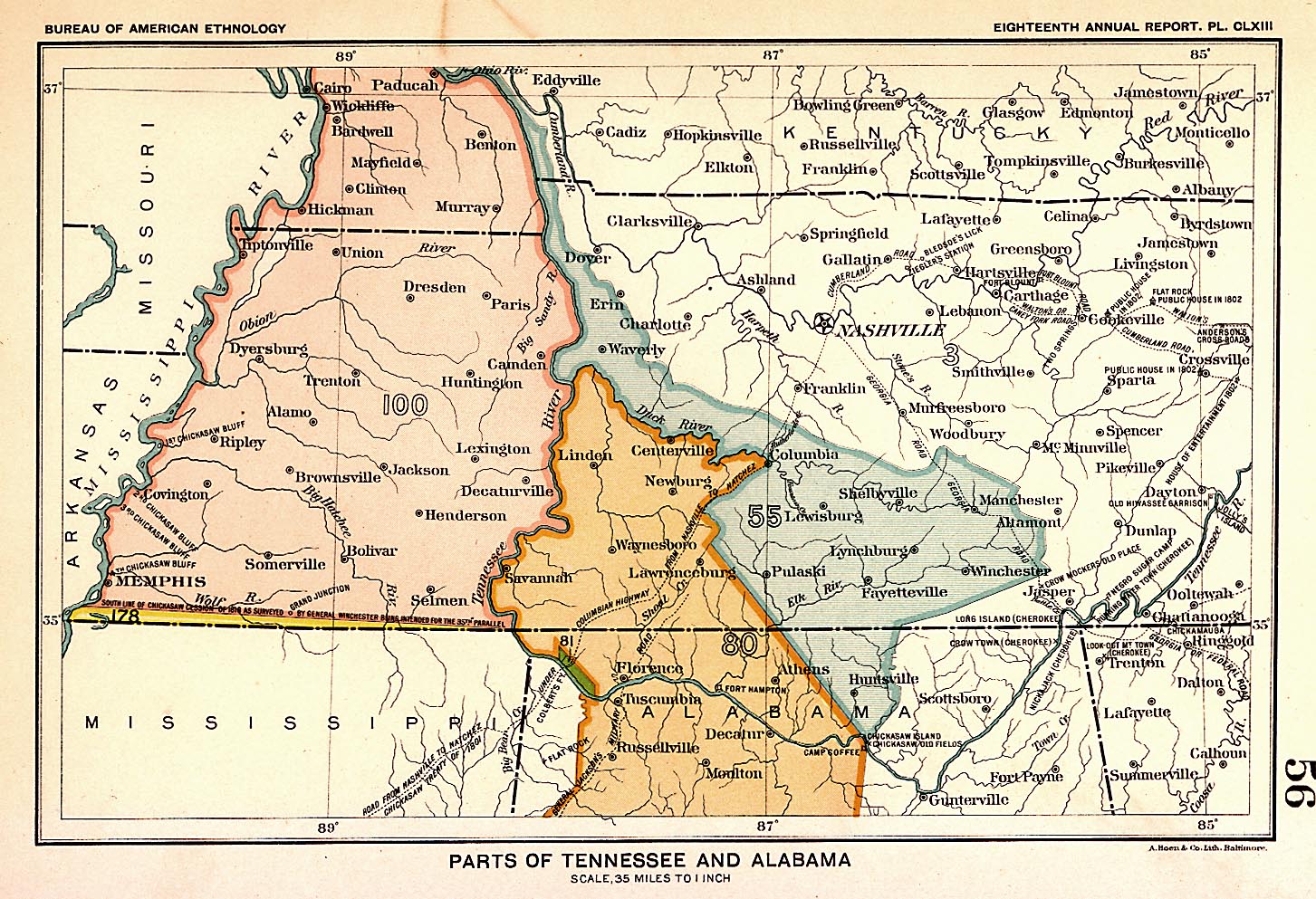
83-86.
Cherokee, 8 Jul 1817
83.
Cherokee, 8 Jul 1817 (
84.
Cherokee, 8 Jul 1817 (
100.
Chickasaw, 19 Oct 1818, The Great Chickasaw Cession. (
101-109.
Cherokee, 27 Feb 1819
101.
Cherokee, 27 Feb 1819 (
102.
Cherokee, 27 Feb 1819 (
103.
Cherokee, 27 Feb 1819 (
104.
Cherokee, 27 Feb 1819 (
105.
Cherokee, 27 Feb 1819 (
106.
Cherokee, 27 Feb 1819 (
107.
Cherokee, 27 Feb 1819 (
108.
Cherokee, 27 Feb 1819 (
109.
Cherokee, 27 Feb 1819 (
178.
Chickasaw, 20 Oct 1832 (
(***).
Chickasaw, 22 Oct 1832. (Supplement to 20 Oct 1832 Treaty)

203.
Cherokee, 29 Dec 1835, Treaty of Removal or Treaty of New Echota, the so called
Trail of Tears Treaty.
http://www.hiddenhistory.com/PAGE3/ww-tenn.htm
http://www.accessgenealogy.com/native/tennessee/index.htm
http://www.indigenouspeople.net/tuskegee.htm
http://www.hiddenhistory.com/page3/swsts/tennsee1.HTM
http://www.hiddenhistory.com/PAGE3/swn-se25.HTM
http://www.hiddenhistory.com/PAGE3/swn-se14.htm
http://www.hiddenhistory.com/PAGE3/swn-se25.HTM
http://www.accessgenealogy.com/native/tribes/shawnee/shawneehist.htm
http://www.tngenweb.org/cessions/colonial.html
The
First People of
Our Aboriginal People of Tennessee map
(93k) shows the Indian cultural groups at about 1700 CE (AD) just after the
beginning of the Historic Period. The map locates the Cherokee, Chickasaw,
Quapaw,
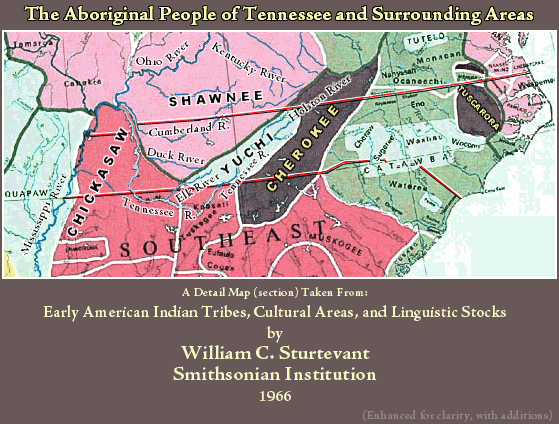
Of these First Nations,
only the Cherokee and Chickasaw treated with the British colonials and/or later
with the
 Cherokee, linguistic group, Iroquian.
In historic times,
Chickasaw, linguistic
group, Muskogian.
In historic
times,
The Nations (or small parts
of them) listed below are believed to have either lived in within the bounds of
modern
Catawba,
linguistic group, Siouan.
In historic times, the Catawba lived in the
“For a brief time in their later history the Catawba lived
among the Cherokee and may have occupied lands in
Chiaha.
“A part of this tribe was encountered by De Soto in 1540,
in the territory now forming this State, probably as shown by Mr. J. Y. Brame,
on what is now Burns Island [South Pittsburg, Marion Cty.
Kaskinampo.
“There is every reason to believe that this tribe constituted
the Casqui, Icasqui, or Casquin ‘province’ which De Soto entered
immediately after crossing the Mississippi River, and it was probably in what
is now Phillips County, Ark. We hear of the Kaskinampo next in connection with
the expeditions of Marquette and Joliet but do not learn of their exact
location until 1701, when they seem to have been on the lower end of present
Mosopelia.
“This tribe probably established themselves on Cumberland
River and at one or two points on the
Muscogee (Creek),
linguistic group, Muskogian.
A northern Georgia Nation whom Ramsey reported as having a
slight presence on the Tennessee River as far north the mouth of the Hiwassee
River.
Then we see ...
“Although we do not have records of any settlements in
In 1729, the pro-Chickasaw
“After being driven from
Quapaw, linguistic group,
Siouan.
Originally from the
See
below.
Tali.
“A tribe met by De Soto near the great bend of the Tennessee
and found in the same region by the earliest English and French explorers,
living in what is now northern Alabama and perhaps also in Tennessee. It is
probable that they were a part of the Creeks.”1
In historic times, the
“One band of
“The later and best know location of this tribe was on the
point of land between Coosa and Tallapoosa Rivers, but in 1685 part of them
were on the Chattahoochie River near modern Columbus [Alabama] and the rest
were on the upper Tennessee near Long Island [Long Island is on the Tennessee
Georgia line].”2
Yuchi (a.k.a. Uchee),
linguistic group, Siouan.
For our purposes, the
Historic Period for
_______
1. The Indian Tribes of
2. Ibid, p. 172.
http://www.indigenouspeople.net/creek.htm